Nowadays, Businesses misuse AI or let’s say using AI in a wrong way and losing trust. We are currently living through a gold rush of automated tools, and while the promise of 10x productivity is enticing, most businesses are accidentally burning their most valuable asset customer trust in the process. It is a strange time to be a consumer; you can almost smell when a brand has stopped “thinking” and started just “processing.”
The reality of 2026 is that automation is no longer a luxury; it’s the baseline. But there is a massive difference between using technology to support your team and using it to replace your conscience. When a customer reaches out with a genuine problem and gets met with a cold, perfectly phrased, but ultimately useless automated response, they don’t see “innovation.” They see a business that has decided their time isn’t worth a human conversation.
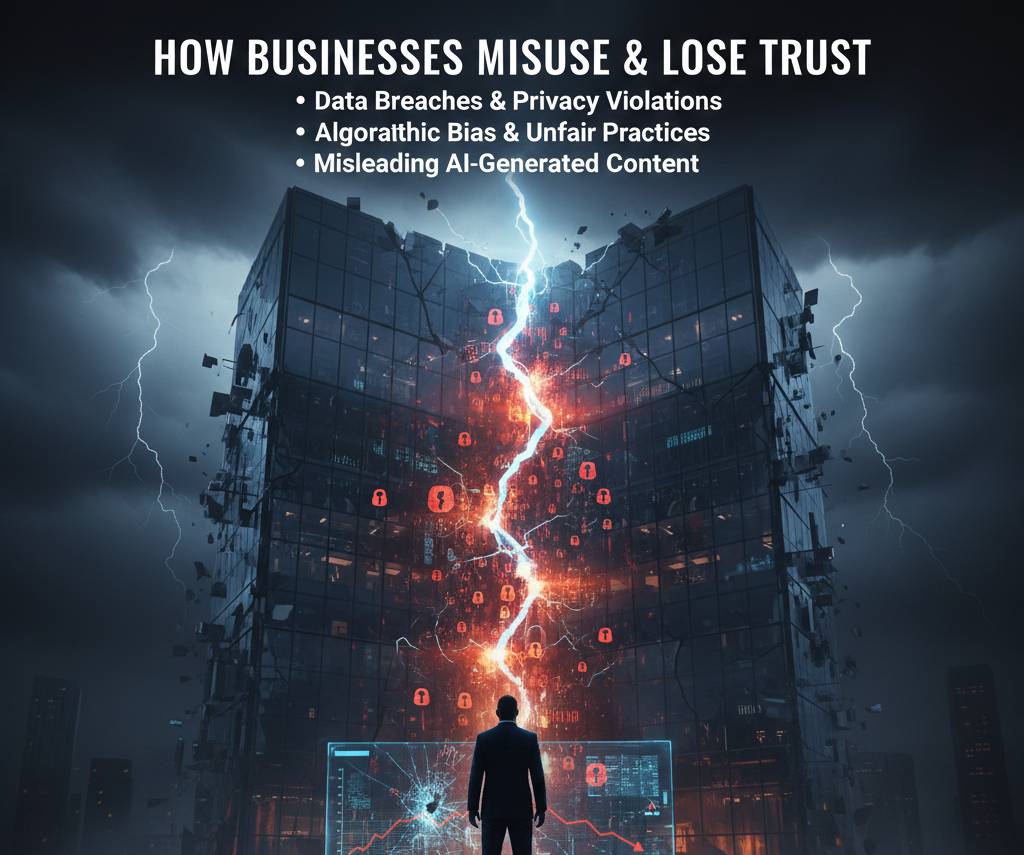
The “Efficiency” Trap: When Speed Kills Connection
Business owners often fall into the trap of thinking that faster is always better. They implement smart chatbots that can handle a thousand queries at once, or automated content engines that can post fifty articles a day. On paper, the metrics look incredible. Costs go down, output goes up, and the spreadsheet looks like a work of art.
But spreadsheets don’t buy products; people do. The misuse of these tools often manifests as a “flattening” of the brand’s personality. If every email, blog post, and customer interaction sounds like it was written by the same overly polite, slightly robotic entity, the brand becomes a commodity. You lose the “why” behind your business. Trust is built on the belief that there is a person on the other side who cares about the outcome. If you automate that care away, you’re just another vendor in a crowded market.
The Content Flood and the Dilution of Expertise: Businesses misuse AI
One of the most common ways businesses are shooting themselves in the foot right now is by flooding the internet with “hollow” content. We’ve all seen it those 2,000-word blog posts that say absolutely nothing new. They are grammatically perfect, optimized for every keyword imaginable, but they offer zero unique insight.
When a potential client comes to your site looking for an expert opinion and finds a generic article that feels like it was put together by a digital blender, you’ve lost them. They realize you aren’t an expert; you’re just someone who knows how to use a tool. This “expertise dilution” is a silent killer. It might help you rank on page one for a week, but it won’t help you close a high-ticket deal. Real trust comes from sharing personal stories, failures, and the kind of “messy” wisdom that a machine simply can’t simulate.
How to Use Automation Without Losing Your Soul
Maintaining trust in an automated world isn’t about avoiding the tools; it’s about being the architect of how they are used. Here is a practical “How to” for keeping your business human-centric.
1. The “Human-in-the-Loop” Mandate
Never let a digital assistant hit “Send” or “Publish” without a human eye on it. This sounds simple, but in the rush to scale, it’s the first rule that gets broken. Your role should move from “Creator” to “Chief Editor.” Use the tools to build the skeleton, but you must provide the heart and the skin.
2. Radical Transparency
If you are using a chatbot for initial customer support, tell the user. Don’t try to pass it off as “Jennifer from Support.” People actually appreciate honesty. A simple message like, “Hey, I’m an automated assistant here to help you get an answer quickly. If I can’t solve it, I’ll get a human on the line immediately,” builds more trust than a fake persona ever will.
YOU CAN ALSO READ:
Industry-specific prompt libraries : HR, sales, support3. Focus on “High-Friction” Personalization
Automation is great for the easy stuff password resets, tracking numbers, and FAQ links. But for “high-friction” moments complaints, custom quotes, or strategic advice you must show up in person. Use the time you saved on the easy stuff to go deeper on the hard stuff.
4. Audit Your Voice
Once a month, read through your outgoing automated communications. Do they still sound like you? Or have they drifted into that bland, corporate “neutral” tone? If you wouldn’t say it that way over a cup of coffee, change the template.
Real-Life Example: The “Perfect” Proposal That Failed
A friend of mine runs a high-end interior design firm. To save time, he started using a smart tool to draft his client proposals. The tool took the client’s requirements and turned them into a stunning, 40-page PDF with perfect formatting and beautiful stock imagery. It was a marvel of efficiency.
He sent it to a long-time prospect, expecting an immediate “yes.” Instead, the prospect called him and said, “This looks great, but I don’t see us in here. It feels like you just plugged my budget into a machine.” He didn’t just lose the contract; he almost lost a decade-old relationship. He spent $2,000 on the software subscription but lost $50,000 in revenue because he let the tool take the steering wheel.
He ended up having to pivot his entire workflow. While he was figuring out how to balance his books after that loss, I told him, “Before you start taking out business loans to cover this gap, ask your financial advisorabout the best way to manage your cash flow during a transition.” It was a expensive lesson in the value of the “human touch.”
The Toolbox: Tools for Monitoring and Quality Control
If you want to stay on the right side of the trust divide, you need tools that help you monitor your automation rather than just adding more of it.
- Originality.ai & Winston AI: Use these to check your own content. If your “expert” articles are getting flagged as 100% automated, you haven’t added enough of your own perspective.
- Gorgias or Zendesk with “Escalation” Rules: These help you set hard boundaries for when a chatbot must hand off to a human. If a customer uses words like “frustrated” or “disappointed,” the machine should step aside immediately.
- FullStory or Hotjar: Use these to watch how people interact with your automated features. If you see people clicking “back” or getting stuck in a loop with your bot, your “efficiency” is actually a barrier.
- Grammarly Business with Style Guides: Instead of letting the tool choose the tone, upload your own style guide so the suggestions actually match your brand’s unique voice.
Practical Tips and Mistakes to Avoid
- Mistake: Automating Empathy. You cannot “automate” an apology. If you’ve messed up a client’s order, a template won’t fix it. A phone call will.
- Mistake: The “Infinite Loop” Bot. There is nothing that kills trust faster than a chatbot that keeps asking the same three questions. Always provide an “Escape to Human” button.
- Tip: Value “Imperfection.” Sometimes a slightly unpolished video or a blog post with a personal anecdote is more effective than a “perfect” piece of corporate content. People trust people, not polished surfaces.
- Tip: Watch Your Tech Spend. It’s easy to think that more tools will solve your problems. Ask your financial advisor if your software-as-a-service (SaaS) stack is actually providing a return on investment or if it’s just bloat that’s eating your margins.
Conclusion: The Premium on Being Real
As we head further into 2026, the market is becoming saturated with “perfectly average” content and interactions. This actually creates a massive opportunity for businesses that choose to stay human. In a world of automated noise, a genuine, thoughtful, and slightly “messy” human connection becomes a luxury product.
Trust is a fragile thing. It’s built in drops and lost in buckets. Use the latest technology to clear the deck of the boring, repetitive tasks that drain your energy. But use that newly found energy to double down on the things that only you can do: listen, empathize, and innovate.
YOU CAN ALSO READ:
Effortless AI Workflow Automation for SolopreneursThe businesses that thrive won’t be the ones with the best algorithms. They’ll be the ones that use algorithms to make their humans more available. Don’t let your tools become a wall between you and the people you serve; let them be the bridge that gets you there faster, so you have more time to stay and talk.
Explore more categories:
https://bygrow.in/category/ai-for-developers-and-technical-limits/
https://bygrow.in/category/ai-in-marketing-seo-and-content-creation/