I Spent 8 Months Confused About Machine Learning. Here’s What Nobody Told Me Upfront.
When I first got into machine learning, I wasted an embarrassing amount of time. I watched YouTube videos about neural networks without understanding basic linear algebra. I set up TensorFlow before I could write a clean for-loop in Python. I tried to build an image classifier before I understood what a classifier even meant.
Nobody told me to slow down. Everybody online was just screaming “learn ML!” without explaining what you’re actually supposed to learn first, in what order, or why half the things they teach you don’t matter until much later.
So let me do that for you.
So What Actually Is Machine Learning?
Here’s the honest version, without the textbook definition:
Machine learning is when you train a program using examples instead of rules. In regular programming, you write exact instructions. “If the email contains this word, mark it as spam.” In machine learning, you show the program thousands of spam emails and thousands of normal ones, and it figures out the pattern on its own.
That’s it. That’s the core idea.
The catch is that it sounds simple until you actually try to do it. Then you realize there are a hundred ways things can go wrong; bad data, wrong algorithm, too many variables, not enough examples. The model learns the wrong thing and confidently does it.
The Part That Trips Almost Everyone Up at the Start
Most people approach machine learning like it’s a software engineering problem. Write the code, run the code, done.
It’s not. It’s closer to science with a heavy engineering layer on top.
You’re basically running experiments. You have data, you have a question, and you’re trying to find a model that answers that question reliably. If your data is bad, your model will be bad. If your question is vague, your results will be meaningless. And you won’t always know which part went wrong.
This is where most beginners mess up. They focus entirely on learning frameworks and libraries; things like TensorFlow, PyTorch, scikit-learn before they understand what the model is actually doing underneath. Then when something breaks, they have no idea why. They just start changing random things and hoping.
Understanding the fundamentals first, even just conceptually, saves you months of that frustration.
What Do You Actually Need to Know Before Writing ML Code?
You don’t need a math PhD. But you do need a working understanding of a few things:
Linear algebra – Just the basics. What a matrix is, what multiplication between matrices means, what vectors are. This is the language the data speaks.
Statistics and probability – Mean, variance, distributions, what “correlation” actually means. This matters more than people think. A lot of bad ML comes from people who don’t understand why their data is skewed or what overfitting actually looks like statistically.
Calculus – Specifically gradients. You don’t need to solve integrals by hand. But understanding that a gradient tells you which direction to adjust a parameter, and that training a model is basically doing this repeatedly, that matters.
You can pick all of this up gradually as you go. But don’t skip it entirely. The people who do almost always hit a wall six months in and don’t understand why.
The Tech Stack – What You Actually Need vs. What’s Just Noise
Here’s where advice online gets really messy. Everyone has an opinion, and a lot of it is outdated or tied to whatever tool they used in their last job.
From what I’ve seen work for most people starting out:
Start with Python. Non-negotiable.
Python is what the ML world runs on. There are ML tools in R and Julia and a few others, but if you’re building a foundation for a career, Python is the answer. Learn it well enough that you’re comfortable with data structures, functions, loops, and working with libraries before you touch anything ML-specific.
YOU CAN ALSO READ:
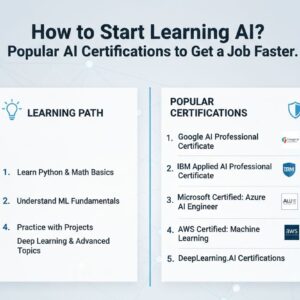
How to start learning AI? Popular AI Certifications to get job faster.Then NumPy and Pandas.
NumPy handles numerical data and arrays — the building blocks of everything in ML. Pandas is for loading, cleaning, and organizing data. You’ll spend more time in these two libraries than you’d expect. Data is almost never clean. Getting comfortable with mess is a skill in itself.
Then Matplotlib or Seaborn for visualization.
Before you run a single model, you should look at your data visually. Distributions, outliers, patterns — a plot shows you things in five seconds that would take an hour to find in a spreadsheet. Skipping this is a mistake I see constantly.
Then scikit-learn.
This is where you actually start doing machine learning. Scikit-learn has clean implementations of most classical algorithms — regression, classification, clustering, decision trees, random forests, and more. It’s well-documented, beginner-friendly, and honestly enough to get you employable in a lot of data science roles if you know it well.
Don’t rush to TensorFlow or PyTorch. Those are for deep learning — neural networks, image recognition, language models. Important, yes. But not where you start.
TensorFlow or PyTorch comes later.
Once you understand classical ML and feel comfortable with scikit-learn, then you move to deep learning. PyTorch is what most researchers use and what’s probably more worth learning now if you’re picking between the two. But this honestly doesn’t matter much until you’ve got everything else solid.
A Real Example of How This Goes Wrong
I know someone who spent three months going through a deep learning course – video lectures, homework, the whole thing. Built a few image classifiers. Got really excited.
Then they got a real-world dataset from an internship. It had missing values, inconsistent formatting, duplicates, and outliers. The model they trained gave wildly wrong results. They had no idea how to diagnose it because they’d never learned data cleaning or how to explore a dataset before feeding it into a model.
Everything they’d learned assumed clean data was already handed to them. Real data never is.
They had to go back and learn the basics they’d skipped. It cost them weeks and a lot of frustration. Don’t be this person.
How Long Does This Actually Take?
Honestly? This depends so much on your background, how much time you’re putting in, and what you’re trying to reach.
If you already know Python reasonably well and can commit to consistent study maybe ten to fifteen hours a week you can get to a point where you understand and can apply classical machine learning in roughly four to six months. That means building real small projects, not just watching videos.
Getting comfortable with deep learning and working with neural networks meaningfully? Probably another four to six months on top of that.
Getting to a point where you can handle ML engineering end-to-end data pipelines, model deployment, production issues that takes over a year in most realistic scenarios.
Anyone telling you to “learn ML in 30 days” is selling you a feeling, not a foundation.
The Mistake Most People Make When Building Their Roadmap
They try to learn too many tools at once.
There’s this pressure to be using Hugging Face and LangChain and MLflow and Docker and cloud platforms and everything else simultaneously because that’s what job postings list. So people spread themselves thin trying to touch everything and end up not really knowing anything.
Pick one path and go deep. Classical ML → deep learning → one deployment approach. That’s enough to be genuinely useful and competitive.
YOU CAN ALSO READ:
Effortless AI Workflow Automation for SolopreneursWhat Actually Matters (That People Usually Ignore)
- Data quality matters more than model choice. A mediocre model on good data beats a fancy model on bad data almost every time.
- Understanding why something didn’t work is more valuable than getting it to work by accident. Don’t just tweak settings randomly until the error goes away. Try to understand it.
- Projects beat certificates. Building something, breaking it, fixing it even something small teaches you more than thirty hours of passive video watching. An actual project on GitHub is worth more than most course completions.
- The gap between “I finished a tutorial” and “I can do this independently” is real. Budget time for that gap. It catches almost everyone off guard.
Practical Things to Consider Before You Start
- Make sure your Python is solid before jumping into ML libraries. If loops, functions, and list comprehensions feel shaky, fix that first.
- Don’t build your entire learning plan around a single Udemy course or bootcamp. Use a few sources. They fill in each other’s gaps.
- Start noticing ML in things you already use. Spam filters, recommendations, autocomplete. Ask yourself how they might work. That curiosity compounds over time.
- Be careful about skipping math entirely because “libraries handle it.” They do until something breaks and you’re staring at output you don’t understand.
- There’s no single best resource. The best one is the one you’ll actually finish.
Machine learning is genuinely learnable. It just takes longer than the marketing around it suggests, and the order in which you learn things matters more than most guides admit.
Explore more categories:
https://bygrow.in/category/ai-for-developers-and-technical-limits/
https://bygrow.in/category/ai-risks-ethics-and-future-trends/