
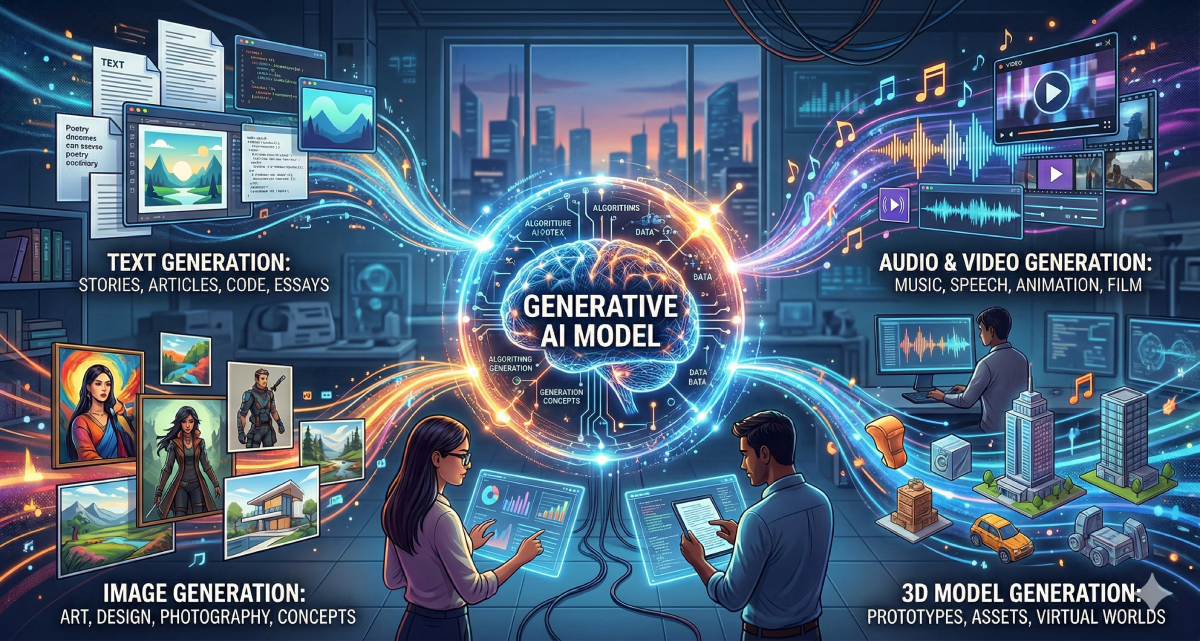
What is Generative AI / Artificial Intelligence?
You know how Google Search finds existing pages on the internet? It doesn’t create anything new – it just finds what’s already there.
Generative AI is different. It actually creates new stuff — text, images, music, code, videos — on its own.
You give it a prompt (basically just ask it something), and it generates a fresh response every single time.
The word “generative” literally means “to generate / create.”
So Generative AI = AI that creates things.
Simple example:
You type: “write me a birthday message for my friend”
→ AI writes one for you from scratch. It didn’t copy-paste it. It made it.
What Is the Main Goal of Generative AI?
At its core, Generative AI has one fundamental goal:
To make creation faster, easier, and more accessible for everyone.
But zoom out, and there are several layers to that goal:
1. Augment Human Capability
GenAI is not built to replace humans — it’s built to extend what humans can do.
A single marketer can now produce content at the scale of a team. A solo developer can build faster with AI writing code alongside them. A student with no design skills can create professional visuals in seconds.
GenAI removes the bottleneck between having an idea and executing it.
2. Democratize Expertise
Before GenAI, getting expert-level output required hiring experts.
- Need a legal draft? Hire a lawyer.
- Need a website? Hire a developer.
- Need ad copy? Hire a copywriter.
GenAI doesn’t replace those experts for complex work — but it gives everyone access to a capable first draft, a starting point, a second opinion.
It levels the playing field between large companies and individuals.
3. Automate Repetitive Creative Work
A huge portion of knowledge work is repetitive:
- Writing the same type of email 50 times
- Summarizing long documents
- Generating product descriptions for 10,000 items
- Translating content into multiple languages
GenAI handles this at scale — freeing humans to focus on work that actually requires judgment, strategy, and creativity.
4. Accelerate Discovery & Innovation
In science, medicine, and research — GenAI is being used to:
- Simulate protein structures (DeepMind’s AlphaFold)
- Generate drug candidates faster
- Analyze research papers and surface insights humans would take years to find
The goal here is to compress timelines — making breakthroughs happen in years instead of decades.
5. Build More Natural Human-Computer Interaction
Traditional computers required you to learn their language — code, commands, clicks.
GenAI flips this. Now computers understand your language — plain English (or any language). You describe what you want, and the system figures out how to do it.
The ultimate goal: a world where the barrier between human intent and computer output is zero.
In one sentence:
The goal of Generative AI is to amplify human potential — by making creation, access to knowledge, and complex problem-solving available to anyone, not just experts.
GenAI vs Traditional AI – What’s the Difference?
Traditional AI analyzes and identifies.
Generative AI goes further and creates.
Think of it like this:
- Traditional AI = a student who can identify answers from a textbook
- GenAI = a student who can write the whole textbook on their own
Tech Stack of Generative AI
You don’t need to be an engineer to understand this.
Core components:
- Large Language Models (LLMs): The brain behind most GenAI tools. Trained on massive text data like books, articles, and code. Examples: ChatGPT, Claude
- Neural Networks: The structure LLMs are built on, inspired by how the human brain works
- Transformers: The architecture that made modern GenAI possible (from Google’s 2017 paper “Attention Is All You Need”)
- Diffusion Models: Used for image generation by turning noise into images step by step (e.g., Midjourney, DALL·E)
- Training Data + GPUs: Billions of examples + massive computing power (GPUs)
- APIs and Cloud: Tools run on cloud platforms like OpenAI, Anthropic, and Google — no local setup needed
Generative AI Examples
Where GenAI is used today:
- Text: Emails, blogs, summaries, legal drafts, ads, social posts
- Images: Photos, art, logos, mockups
- Code: Writing, debugging, explaining code
- Audio: Voice cloning, music, podcasts
- Video: Generating videos from prompts
- Search & Research: Answering complex questions with reasoning
Generative Artificial Intelligence Chatbot
A GenAI chatbot is a chat interface that lets you talk to AI like a normal conversation.
You type something, the AI understands it, generates a reply, and continues the conversation while remembering context.
Popular chatbots:
- ChatGPT — OpenAI
- Claude — Anthropic
- Gemini — Google
- Copilot — Microsoft
These are not simple bots. They:
- Understand context
- Handle follow-up questions
- Adjust tone
- Generate new responses every time
Generative Artificial Intelligence Models
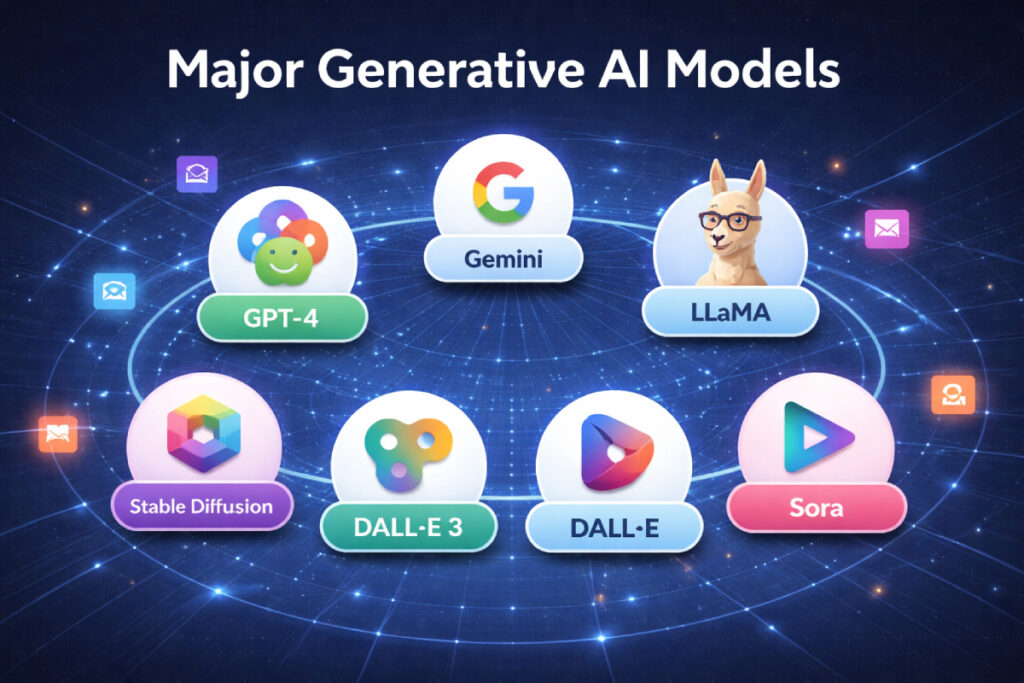
A model is the trained brain of AI — the system that learned from data and now generates content.
Major models to know:
- GPT-4 / GPT-4o — OpenAI
- Claude 3 / Claude 4 — Anthropic
- Gemini 1.5 / 2.0 — Google
- LLaMA — Meta (open-source)
- Stable Diffusion — open-source image model
- DALL·E 3 — OpenAI image model
- Sora — OpenAI video model
Each model has different strengths — some are better at coding, some at writing, some at reasoning, and some at images.
Is ChatGPT / Claude AI Generative Artificial Intelligence?
Yes, 100%.
- ChatGPT → OpenAI → GPT models → Generative AI
- Claude → Anthropic → LLM → Generative AI
They generate new responses every time. They don’t copy answers — they create them dynamically.
How GenAI Actually Work?
You don’t need to know the math — but here’s the intuition.
When you type a prompt, the AI doesn’t “look up” an answer. It predicts the most likely next word, then the next, then the next — until a full response is built.
Think of it like autocomplete on steroids.
Step-by-step (simplified):
- You enter a prompt — the AI receives your text as input
- It breaks it into tokens — small chunks of words or characters
- It calculates probabilities — based on everything it learned during training, it figures out what words/ideas should logically come next
- It generates, word by word — building a response in real time
- You see the output — text, image, code, audio — depending on the model
This is why two people asking the same question get slightly different answers. The model introduces controlled randomness (called temperature) to make responses feel natural, not robotic.
Multimodal AI — When AI Handles Everything at Once
Most early AI models were single-modal — text in, text out.
Multimodal AI breaks that limit. It can accept and generate across multiple formats — text, images, audio, and video — all in one model.
Examples:
- Show AI a photo of your fridge → it writes a recipe from what it sees
- Upload a PDF → ask questions about it in chat
- Speak a prompt → get a spoken response back
Models doing this today:
- GPT-4o (OpenAI) — text, image, audio
- Gemini 1.5 (Google) — text, image, video, audio
- Claude 3.5+ (Anthropic) — text and vision
This is where AI is heading — one model that understands the world the way humans do: through multiple senses.
Prompt Engineering — The Skill of Talking to AI
A prompt is what you type into an AI. Prompt engineering is the skill of typing it well.
Same question, very different results — depending on how you ask.
| Weak Prompt | Strong Prompt |
|---|---|
| “Write an email” | “Write a professional follow-up email to a client who missed our meeting. Keep it under 100 words. Friendly but firm tone.” |
| “Explain AI” | “Explain generative AI to a 15-year-old with no tech background, using 3 simple analogies” |
Core prompting techniques:
- Be specific — vague inputs give vague outputs
- Give context — who you are, what the goal is
- Set format — bullet points, table, paragraph, word count
- Use examples — show AI what you want the output to look like
- Assign a role — “Act as a marketing expert and…”
Prompt engineering is now a real job title. Companies hire people just to get better results out of AI tools.
Foundation Models vs Fine-Tuned Models
This distinction is missing from most beginner guides — but it matters.
Foundation Model: A general-purpose model trained on massive, broad data. It can do many things reasonably well.
- Examples: GPT-4, Claude, LLaMA
Fine-Tuned Model: A foundation model that has been further trained on a specific dataset to specialize in one area.
- Example: A legal AI trained additionally on court documents and contracts
- Example: A medical AI trained on clinical notes and research papers
Analogy:
- Foundation model = a smart college graduate who knows a bit of everything
- Fine-tuned model = that same graduate after completing a medical residency
Most enterprise AI tools you see in healthcare, law, and finance are fine-tuned versions of public foundation models.
Limitations of Generative AI
Hallucinations get all the press — but there are more limitations worth knowing.
| Limitation | What It Means |
|---|---|
| Hallucinations | Confidently generates false information |
| Knowledge cutoff | Doesn’t know events after its training date |
| No real-world understanding | Has no lived experience, common sense can fail |
| Bias | Reflects biases present in training data |
| Context window limits | Can only process a certain amount of text at once |
| Copyright ambiguity | Trained on internet data — ownership of outputs is legally grey |
| No persistent memory | Most models forget the conversation once it ends |
This is why human oversight still matters — especially in high-stakes decisions.
Generative AI Across Industries
Beyond content types — here’s where GenAI is transforming entire sectors:
| Industry | How GenAI Is Being Used |
|---|---|
| Healthcare | Summarizing patient records, drug discovery, medical imaging analysis |
| Legal | Contract review, case research, document drafting |
| Finance | Fraud detection reports, earnings summaries, financial modeling assistance |
| Education | Personalized tutoring, quiz generation, lesson planning |
| Retail/E-commerce | Product descriptions, customer support bots, personalized recommendations |
| Marketing | Ad copy, A/B test variations, campaign ideation at scale |
| Software | Code generation, bug fixing, documentation writing |
| Entertainment | Scriptwriting assistance, game NPC dialogue, music composition |
The common thread: GenAI handles the first draft or repetitive layer — humans handle judgment, strategy, and final decisions.
Cost & Accessibility
GenAI tools range from completely free to enterprise-level pricing.
Free tiers (good for personal use):
- ChatGPT (GPT-4o mini) — free
- Claude (claude.ai) — free tier available
- Gemini — free
Paid tiers (more power, higher limits):
- ChatGPT Plus — ~$20/month
- Claude Pro — ~$20/month
- Gemini Advanced — ~$20/month
API access (for developers building products):
- Priced per token (per chunk of text processed)
- OpenAI, Anthropic, Google all offer APIs
- Costs scale with usage
Open-source alternatives (free to run yourself):
- Meta’s LLaMA — can run locally on your own hardware
- Mistral, Falcon, Phi — various open models with different strengths
Bottom line: You can start using GenAI today for free. The paid tiers unlock faster speeds, longer context, and access to the most capable models.
What Are Some Ethical Considerations When Using Generative AI?
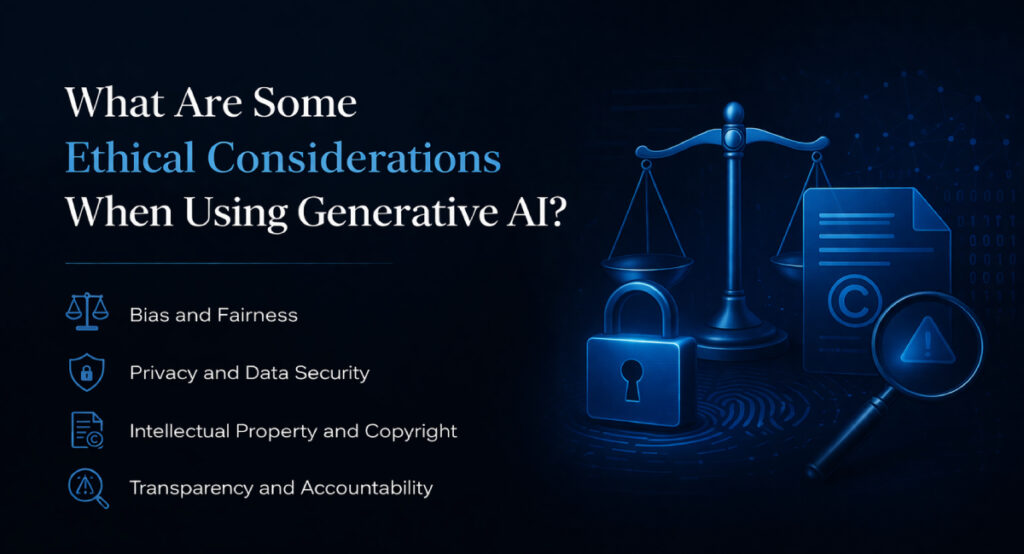
GenAI is one of the most powerful tools ever built. And like any powerful tool, how you use it matters enormously.
Here are the key ethical considerations everyone — individuals, businesses, and developers — should keep in mind:
1. Honesty & Transparency
The question: Should you disclose when content is AI-generated?
The concern: Passing off AI content as entirely human-made can mislead readers, clients, employers, and audiences.
The expectation forming: In journalism, academia, and professional services, disclosure is increasingly expected — and in some cases, required.
Ethical use means being transparent about AI’s role in your work — especially when trust is on the line.
2. Misinformation & Responsible Sharing
GenAI can generate convincing, fluent text about things that are completely false.
- Fake news articles that look real
- Fabricated quotes from real people
- Plausible-sounding but incorrect medical or legal advice
The responsibility: Before sharing or publishing AI-generated content, verify it. AI output is a draft — not a source of truth.
Using GenAI responsibly means not amplifying misinformation — even unintentionally.
3. Privacy & Data
Two concerns here:
a) What you share with AI: When you paste personal data, client information, or confidential business details into an AI tool — that data leaves your device and reaches a company’s servers. Some tools use conversations to train future models.
b) What AI was trained on: Many models were trained on internet data that may include personal information people never consented to have used for AI training.
Ethical use means being careful about what you input — and being aware of how your data is handled.
4. Bias & Fairness
AI learns from human-generated data. Human data contains human biases — racial, gender, cultural, socioeconomic.
If those biases aren’t actively corrected during training, the model inherits and scales them.
Real examples:
- AI image generators historically produced whiter, more Western-looking people by default
- AI hiring tools showing preference for certain demographics
- Translation tools performing worse for lower-resource languages
Ethical use means questioning AI outputs — especially in decisions that affect people’s lives.
5. Copyright & Intellectual Property
GenAI models were trained on text, images, music, and code created by humans — often without explicit permission or compensation.
Unresolved questions:
- Who owns AI-generated content — the user, the company, or nobody?
- Can AI-generated art infringe on the style of a human artist?
- Is code generated from open-source training data subject to those licenses?
Courts and governments are still working through this. Until it’s resolved:
Ethical use means not passing AI-generated work off as wholly original when it draws from others’ creative work — and staying informed as laws evolve.
6. Over-Reliance & Critical Thinking
The easier AI makes creation, the easier it becomes to stop thinking critically.
Risks of over-reliance:
- Accepting AI answers without verifying them
- Losing the skill of writing, coding, or reasoning independently
- Making decisions based on confident-sounding AI output that is subtly wrong
Ethical use means treating AI as a tool that supports your thinking — not one that replaces it.
7. Job Displacement & Economic Impact
GenAI will automate tasks that people currently get paid to do. That’s not a distant prediction — it’s already happening.
The ethical tension:
- Businesses benefit from efficiency and cost savings
- Workers in affected roles face real disruption
What ethical use looks like at an organizational level:
- Retraining and upskilling employees rather than simply replacing them
- Being transparent with teams about how AI is being adopted
- Considering the human cost of automation decisions — not just the financial upside
8. Deepfakes & Consent
AI can now generate realistic video, audio, and images of real people — saying or doing things they never did.
This raises serious consent issues:
- Using someone’s likeness without permission
- Creating fake audio of a person’s voice
- Generating images of real people in fabricated scenarios
Ethical use includes pushing for — and choosing — AI providers committed to sustainable infrastructure.
The bottom line on AI ethics:
GenAI is a mirror — it reflects the intentions of the people using it. The technology itself is neutral. The ethics come entirely from how, why, and for whom it is used.
The goal isn’t to be afraid of GenAI — it’s to use it with intention, honesty, and awareness of its impact on others.
FAQs
Q1 – Is Generative Artificial Intelligence capable of clinical reasoning?
Short answer: partly yes, but not reliable enough alone.
GenAI models can:
- Perform well on medical exams
- Suggest diagnoses
- Explain symptoms
- Summarize medical records
But the problem: hallucinations (confident wrong answers)
Conclusion:
- Used as an assistant
- Not a replacement for doctors
- Final decisions still require human judgment
Q2 – Will Generative AI replace jobs?
Short answer: It will replace tasks, not entire jobs — but some roles will shrink.
Jobs most affected: data entry, basic content writing, customer support scripting, simple coding tasks.
Jobs least affected: those requiring physical presence, deep human judgment, emotional intelligence, or creative leadership.
The realistic view: Most knowledge workers will use AI as a tool, making them more productive — similar to how spreadsheets changed accounting. New jobs are also being created: prompt engineers, AI trainers, AI auditors, AI product managers.
Q3 – Can AI-generated content be detected?
Sometimes — but not reliably.
Tools like GPTZero and Turnitin attempt AI detection. They look for statistical patterns in how AI writes — but accuracy is inconsistent. False positives (flagging human writing as AI) are a real problem.
As models improve, detection becomes harder. Watermarking at the model level is a more promising long-term solution.
Q4 – Does GenAI understand what it’s saying?
No — not in the way humans do.
It identifies statistical patterns in language. It doesn’t have opinions, feelings, or awareness. When it says “I think,” that’s a learned language pattern — not genuine thought.
This is the difference between narrow intelligence (very good at specific tasks) and general intelligence (true understanding). GenAI is the former.
You can learn more about it on wikipedia.
You can learn about machine learning here:
https://bygrow.in/machine-learning-ai-explained-the-simplest-guide-ever/