
Company Overview: What is MIDHANI?
Mishra Dhatu Nigam Limited or nse midhani – Established in 1973 in Hyderabad, Mishra Dhatu Nigam Limited (MIDHANI) is a Public Sector Undertaking (PSU) operating under the Ministry of Defence. It serves as India’s premier manufacturer of ultra-specialized metals—producing materials at a scale and quality that are exceptionally rare within the domestic market.
Core Portfolio & Clients:
The company specializes in titanium alloys, super alloys, special/armour steels, and maraging steel. Recently, MIDHANI has been expanding into value-added products, including bulletproof jackets, aerospace fasteners, castings, welding electrodes, and springs. Its primary clientele includes major national organizations like ISRO, DRDO, HAL, and Indian Navy shipyards, alongside a growing list of global aerospace importers.
Recent Financial Performance:
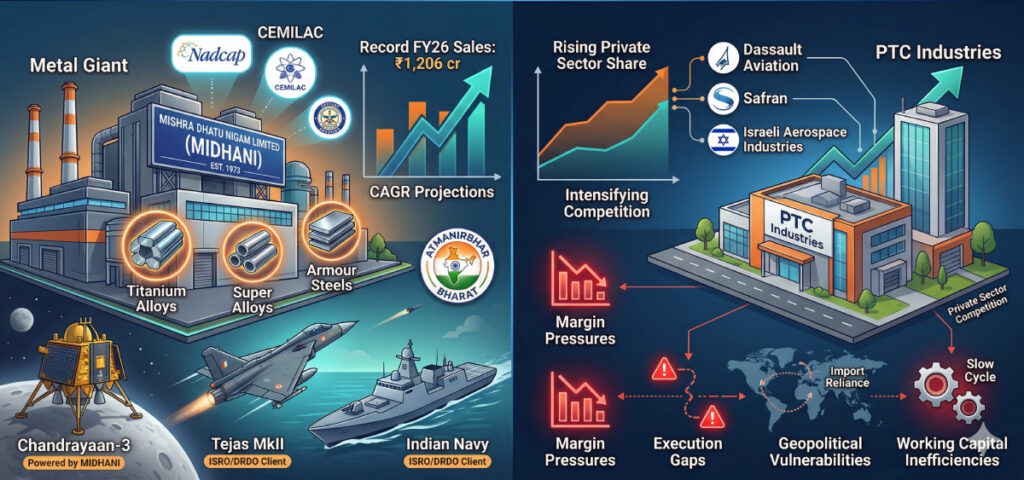
For the fiscal year 2026 (FY26), MIDHANI reported its highest-ever sales figure of ₹1,206 crore. This represents a 12% year-over-year growth, with export revenues accounting for ₹85 crore of the total.
Competitive Positioning and Industry Moat
MIDHANI holds a challenging position in the specialized metals sector, though the landscape is evolving.
Dominant Market Position: As the sole PSU manufacturing titanium and nickel alloy steels in India, it provides a crucial, cost-effective alternative to imported materials. Notably, over 80% of the company’s orders are secured on a nomination basis, meaning they bypass traditional tendering processes.
Integral to National Programs: MIDHANI’s materials are foundational to India’s space and defence programs. Its products are utilized in the PSLV, GSLV, LVM3 rocket boosters, Chandrayaan-3, and Gaganyaan. Furthermore, the company recently delivered its first consignment of superalloy and titanium components to HAL for the Tejas MkII airframe.
High Barriers to Entry: The company has spent decades acquiring rigorous technical certifications. In FY26, it achieved the NADCAP certification for heat treatment and CEMILAC certification for superalloy cast sticks.
Single-Crystal Technology: MIDHANI is currently the only domestic melter capable of producing the raw material required for single-crystal turbine blades, making it a mandatory supplier for local aero-engine blade manufacturers.
Capacity Expansion: In June 2025, the company inaugurated its second Titanium Plant in Hyderabad, which is now recognized as India’s largest state-of-the-art facility for aerospace-grade titanium alloys.
The Competitive Shift: While MIDHANI is dominant, private sector competition is heating up. PTC Industries is currently establishing four manufacturing facilities for superalloy and titanium production. PTC has already secured long-term contracts with international aerospace giants like Dassault Aviation, Safran, and Israeli Aerospace Industries.
Key Business Drivers and Growth Factors
Several foundational elements are supporting MIDHANI’s ongoing business trajectory:
- Operational Milestones: FY26 brought significant operational wins, including a roughly 40% increase in titanium output and the successful acquisition of 10 CEMILAC certifications for various superalloy bars and castings.
- The Indigenization Push: India is actively working to develop domestic aero-engines (such as the Kaveri dry engine, Manik STFE, AMCA, and Tejas MkII). MIDHANI serves as the core raw material backbone for these projects.
- Shift to Value-Added Products: Moving beyond basic raw materials, the company’s expansion into titanium structures, aerospace fasteners, and bulletproof systems is a strategic pivot designed to improve overall profit margins.
- Strong Order Book: The company maintains an order pipeline between ₹2,440 and ₹2,594 crore, of which approximately 72% originates from the defence sector. This provides clear revenue visibility for more than two years.
- Analyst Projections: Brokerage firm ICICI Securities has estimated a revenue Compound Annual Growth Rate (CAGR) of about 17% and a Profit After Tax (PAT) CAGR of 30% for the FY25–FY28 period.
- Government Policy Support: The overarching Atmanirbhar Bharat (Self-Reliant India) initiative directly translates into business for MIDHANI, as every effort to substitute defence imports results in domestic orders.
Upcoming Milestones to Watch
The company’s management has publicly stated a long-term goal of reaching ₹2,000 crore in revenue over the next decade. Several upcoming catalysts could influence this timeline:
- Capacity Expansion (Expected Q1 FY27): The formal announcement of a much-anticipated capital expenditure (capex) plan to scale operations.
- New Revenue Streams (FY27): Potential progress on the ₹1,000 crore ABHED bulletproof jacket tender.
- Railway Integration (FY27): Anticipated RDSO certification for Vande Bharat springs, which would open a new supply vertical.
- Export Scaling (1–2 Years): Potential certifications from global OEMs (like Safran), which would significantly expand export capabilities.
- Sector Ramp-Ups (Ongoing to 5 Years): Steady compounding of orders tied to ISRO’s Gaganyaan missions, HAL’s Tejas MkII, and the AMCA programs, alongside sustaining the recent 40% growth in titanium output.
Business Risks and Challenges
To present a complete picture, several operational and structural risks must be acknowledged:
- Execution and Target Misses: Revenue realization can be lumpy. For example, while FY26 delivered record sales of ₹1,206 crore, it fell short of the company’s own internal ₹1,300 crore target.
- Margin Pressures: Actual margins have occasionally missed guidance. The actual EBITDA margin in Q3 was 19.7%, trailing the company’s stated target of 23%.
- Intensifying Competition: The rapid growth and international partnerships of private players like PTC Industries present a formidable, accelerating challenge to MIDHANI’s historical monopoly.
- Geopolitical Vulnerabilities: Despite paying necessary duties, the company relies heavily on raw material imports (particularly from Eastern Europe), exposing its supply chain to global geopolitical disruptions.
- Capital Inefficiencies: The business suffers from a high working capital requirement. A lengthy inventory cycle of 3 to 5 months acts as a drag on overall financial returns.
- Capex Uncertainty: Until a concrete capacity expansion plan is officially detailed, projecting sustained growth beyond current levels remains highly speculative.
Company Official Website:
https://midhani-india.in
Disclaimer: This article is for informational and educational purposes only. It does not constitute financial, investment, or trading advice. Always conduct your own due diligence or consult with a certified financial advisor before making investment decisions.